
14th August 2026
By Peter Coles
The exceptional hot, dry weather has been taking its toll on our trees, both young and old. And some of our heritage mulberry trees are no exception. In this article we look at some steps we can take to minimise the stress during a heatwave, and, importantly, to help boost a tree’s resilience in the face of increasingly frequent hot weather.
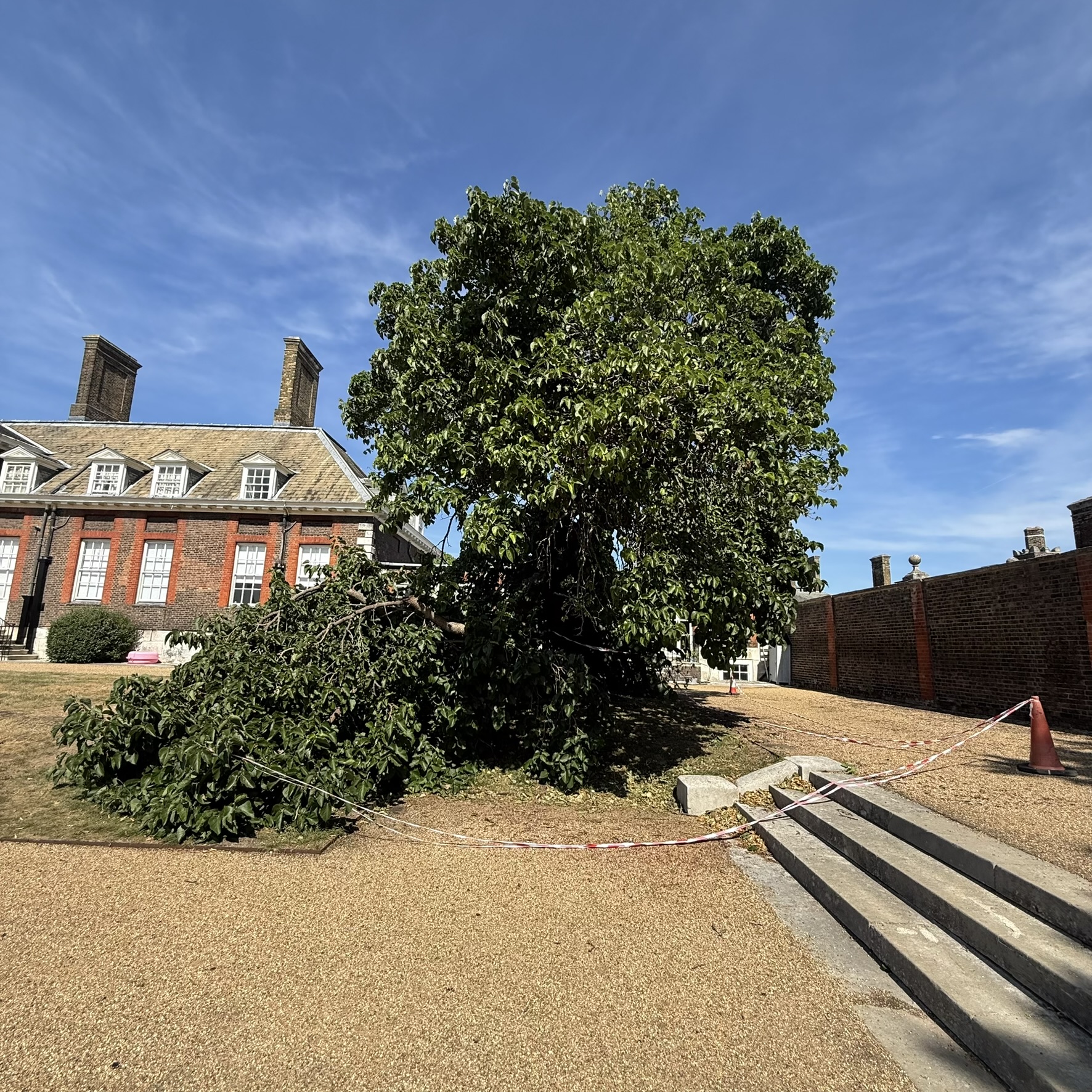
Royal Chelsea Hospital mulberry - a casualty of the heatwave
A recent casualty of the current heatwave has been the handsome black mulberry on the south (Thames) side of the Royal Chelsea Hospital (home of the celebrated Pensioners). It was planted in 1952 to celebrate Queen Elizabeth II’s coronation. In early July I had a standing invitation from Ric Glen, Head of Grounds and Gardens, to sample the juicy ripe mulberries. Instead, he emailed to say that a whole large branch had failed. “It will require work and will be an altered tree when you next visit,” he wrote.
Sure enough, when I stopped by a few days later, a substantial part of the tree, poignantly laden with ripe and ripening fruit, had sheared from the trunk. The bough was now on the ground, sporting a crown of dead leaves.
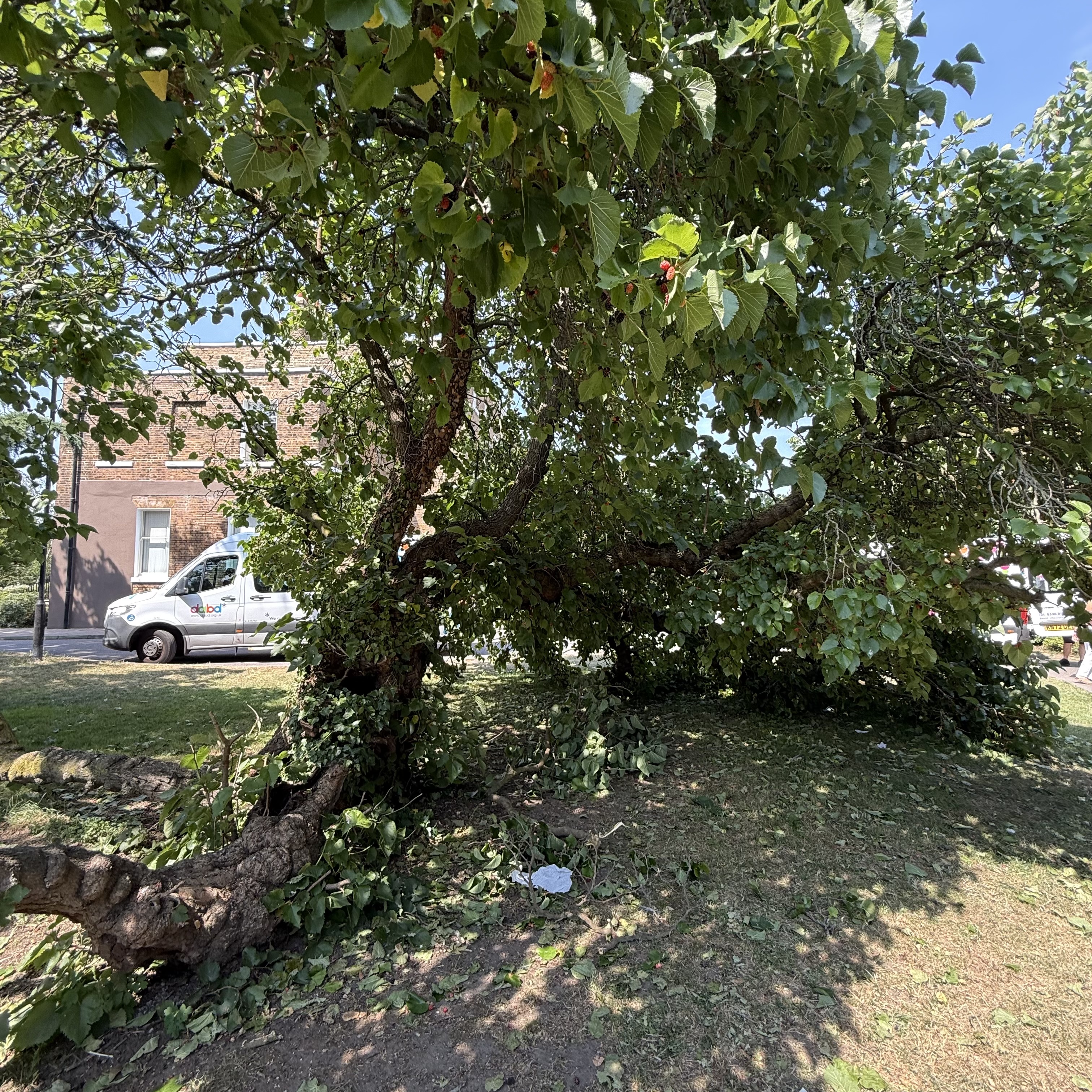
Leytontone House mulberry has a drooping branch
This came on the back of a similar, but fortunately (so far) less catastrophic failure in another heritage London mulberry. In March, a large branch of the 200-year-old mulberry at Leytonstone House, had drooped significantly and was now resting on the ground. This alarmed those who know the tree, including local historian Claire Weiss, who has written about its history for Morus Londinium. Discussions are underway between Council tree officers, Claire and the owners to take measures to protect the tree from further failure and prolong its life. Morus Londinium has offered some suggestions, too. Fortunately, both trees are vigorous and appear to have survived the stress so far, but watch this space for updates.
Prevention better than cure
A recently planted mulberry tree – like any young tree – needs a lot of water in the first three years. Ideally this comes in the form of a thorough drenching (20 litres or so) at least once a week, rather than the “little and often” strategy we might think of giving it. This is to encourage the tree to establish a healthy root system and eventually fend for itself. Young fruit trees in community gardens are exempt from hosepipe bans,.
A thick (10 cm or so) layer of organic mulch (like well-rotted woodchip, or leaf mould) around the tree will provide nutrients, encourage root development and mycorrhizal fungi, and help keep the soil moist. Remember to leave a doughnut gap of a few centimetres around the base of the trunk. Mulch touching the bark will probably cause it to rot.
Unlike a sapling, an old or ancient tree will have developed an extensive and efficient root system. Rather than drenching the tree with water, the greatest favour we can do is to protect this root system. The roots of black mulberry trees do not go deep (often only 30 cm or so) but they do spread out a long way. So, again, mulch, mulch, mulch – this time out to the dripline or beyond.
The dripline of an old tree can have a radius many metres from the base of the trunk. And the dripline of a collapsed tree, lying on the ground and sending former branches up as new trunks, may have an irregular and complex shape.
Root compaction
A sad reality is that hugging (by too many people) can kill the thing we love. Repeated footfall over decades and centuries can make the soil around a tree as hard as concrete. Eventually the roots will die from lack of oxygen, killing the tree. In severe cases air can be injected into the root system (by a professional) but mulching and minimising footfall are simple, long-term preventive strategies.
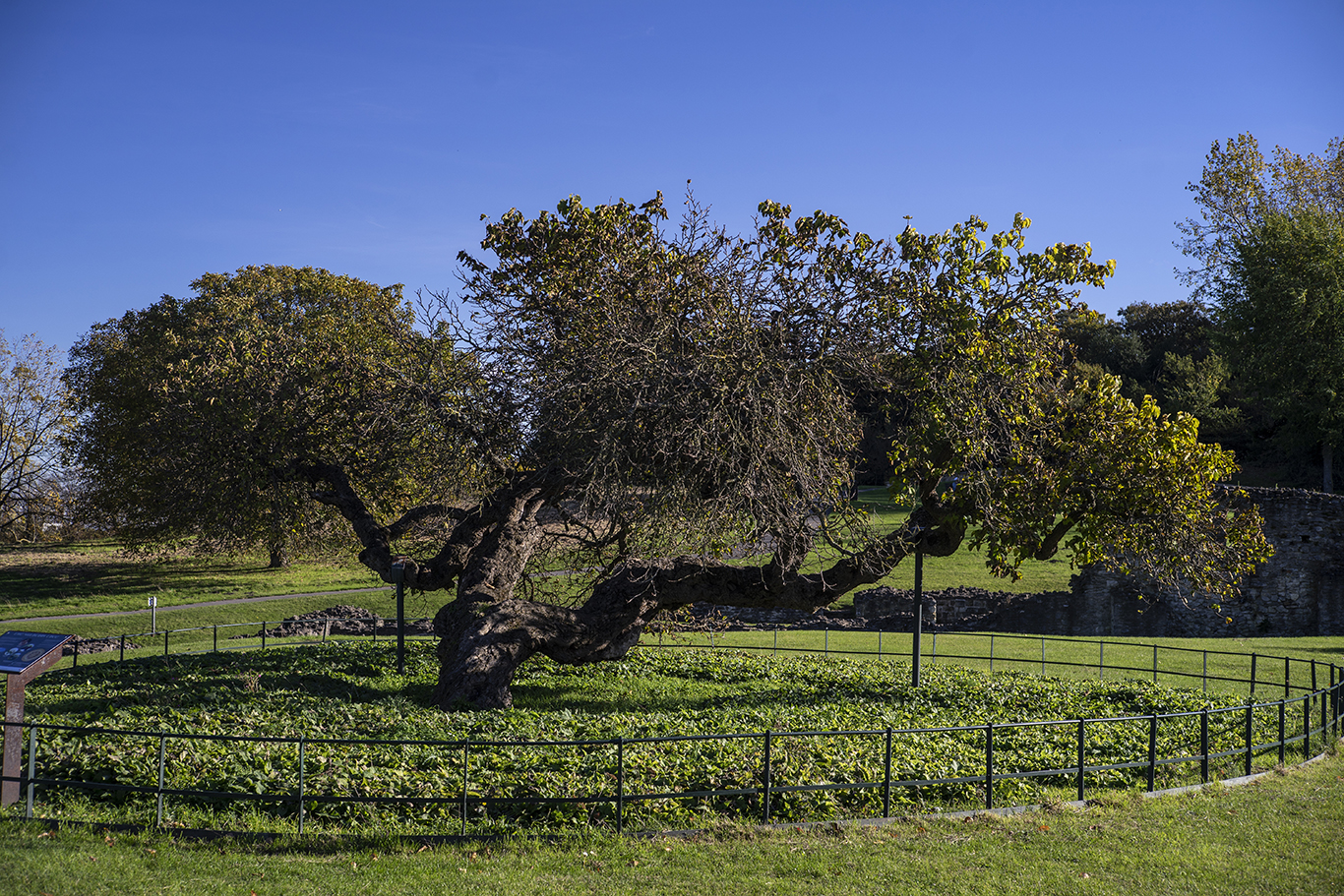
Good practice: Lesnes Abbey mulberry protected against root compaction
The root system of a veteran tree can be much larger than we think – the “root protection area” is defined as 15 times the diameter of the trunk measured at 1.5 metres. This is the area that should be as free of stressors (including plant and heavy machinery, footfall, storage, etc) as is feasible. In some cases, a low fence, combined with mulch, will suffice to keep the public at a distance. In other cases, a belt of brambles or cut branches can be effective, while serving as habitat for small mammals and insects. Planting wildflowers, like comfrey, can also help keep tree-lovers at a distance while adding to the aesthetics.
If there is a conflict of interest, e.g. with a footpath, can this be diverted? We’ve heard of owners and managers of parkland wanting to fell a tree overhanging a path…. The path has near-zero biodiversity value compared to an old tree and can often be diverted by a few metres.
There's plenty of help online. Here are a few excellent resources:
Online resources
https://www.woodlandtrust.org.uk/media/51153/ancient-and-veteran-trees-an-assessment-guide.pdf
All images (c) Peter Coles


